Internal links shape how search engines discover, prioritise, and understand your pages; yet they're often treated as an afterthought or left to emerge from navigation defaults. This article covers the mechanics of link equity flow, anchor text signals, and information architecture, with frameworks for diagnosing problems and intervening at scale.
What internal linking controls
Internal links are hyperlinks pointing from one page on a domain to another page on the same domain. They have four distinct functions in search engine optimisation, each of which can be optimised independently.
Crawl path discovery: Search engine crawlers find pages by following links. A page with no internal links pointing to it can only be discovered through external links or XML sitemaps. Pages discovered solely through sitemaps receive a weaker priority signal than pages woven into the site's link structure.
Equity distribution: Links pass ranking signals from one page to another. A page accumulates equity from the links pointing to it (both internal and external) and distributes a portion of that equity through its outbound links. Internal linking architecture determines how this equity flows through your site.
Contextual relevance: The anchor text and surrounding content of a link communicate what the destination page is about. Internal links reinforce topical associations, helping search engines understand page content and its relationship to other pages on the site.
User engagement: Internal links keep visitors on your site longer, reduce bounce rates, and increase pages per session. While the direct ranking impact of these behavioural metrics remains debated, the indirect benefits are clear; users who explore more content are more likely to convert, share, or link externally.
These four functions operate simultaneously. A navigation link aids discovery and passes some equity but provides minimal contextual signal. A contextual link within article body text contributes to all four.
Internal links operate within a trust boundary. Search engines assume your site is self-consistent: you're unlikely to link to your own spam. This differs from external links, where trust must be established. Internal links carry different weight characteristics as a result: more controllable, but individually less impactful than a quality external link.
Link equity as a flow system
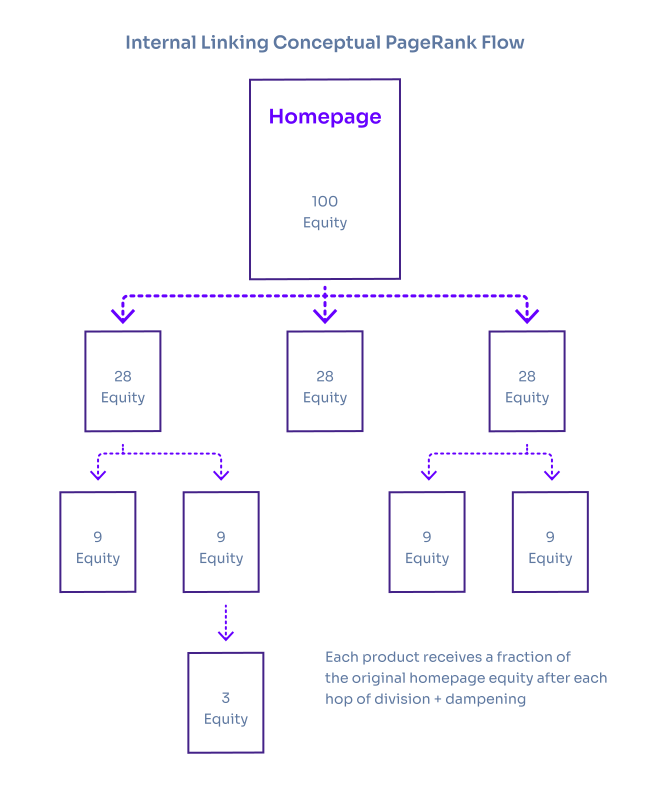
Link equity—or "PageRank" after Google's original algorithm—flows through a site like water through pipes. Each page acts as both a reservoir (accumulating equity from inbound links) and a distributor (passing equity through outbound links).
The conceptual model works as follows:
- Each page accumulates equity from all links pointing to it, whether internal or external
- That equity divides across all outbound links from the page
- Each hop includes dampening, so some equity is lost rather than passed forward
- The process continues recursively across the entire site
A page with ten outbound links distributes roughly one-tenth of its passable equity through each link. A page with one hundred outbound links distributes roughly one-hundredth per link. This creates a fundamental tension: comprehensive navigation aids users and discovery but dilutes equity per link.
Dampening and distance
Equity doesn't flow indefinitely. Each hop between pages reduces the amount passed. A page three clicks from a high-equity source receives a fraction of what reaches a page one click away. This isn't only because of dilution across links, but also because of cumulative dampening at each step.
This is why click depth matters for SEO independently of URL structure. A page at /category/subcategory/product/ can receive strong equity if directly linked from the homepage. A page at /page/ can be equity-starved if only reachable through a long chain of intermediate pages.
Redirects create additional hops with their own dampening. When URL A redirects to URL B, links pointing to A must traverse the redirect before reaching B. This is one reason site migrations carry inherent ranking risk even with technically correct redirect implementation.
Practical implications
This flow model explains several observable SEO phenomena:
- Homepage authority: Homepages typically accumulate the most equity because they receive the most internal links (via navigation) and often the most external links
- Category page strength: Category pages linked from navigation and from many child pages accumulate equity from both directions
- Deep page weakness: Pages many clicks from high-equity sources struggle to rank, regardless of content quality
- Link bloat penalty: Sites with massive navigation menus dilute equity across hundreds of links per page, weakening the signal to any individual destination
Anchor text and topical signals
Anchor text (the clickable text of a hyperlink) tells search engines what the destination page is about from the linking page's perspective. When multiple pages link to a destination using consistent anchor text, that reinforces the destination's topical associations.
Internal anchor text carries less weight than external anchor text. You're vouching for yourself, which search engines appropriately discount. However, internal anchors are fully controllable, making them valuable for reinforcing topical clarity across a large site.
Consistency reinforces, inconsistency dilutes
If ten internal links point to your running shoes category using anchors like "running shoes," "running footwear," "shoes for running," and "jogging trainers," the signal is fragmented. If all ten use "running shoes," the association is reinforced.
This doesn't mean robotic repetition. Natural variation is fine: "running shoes," "our running shoes collection," "browse running shoes." The principle is avoiding anchor text that conflicts with or obscures the destination page's primary topic.
The line between useful and manipulative
Anchor text should describe the destination accurately. A link reading "running shoes" pointing to a running shoes category page is natural and helpful. A link reading "best cheap running shoes buy online free shipping" is keyword-stuffed and looks manipulative.
The test: would a human editor write this anchor text to help readers navigate? If yes, it's appropriate. If it reads like an attempt to game keyword matching, it will likely be discounted or could trigger quality filters.
Audit anchor text consistency for your most important pages. If internal links use wildly varying anchors, or worse, generic anchors like "click here" or "learn more", you're missing an opportunity to reinforce topical signals.
Information architecture and implicit link hierarchies
Internal linking doesn't exist in isolation. It emerges from information architecture decisions: how content is organised, categorised, and related. Every IA choice creates implicit linking patterns.
How IA generates links
Navigation systems: Primary navigation, footer links, and sidebar menus create site-wide links to pages included in those elements. A page in the main navigation receives a link from every page on the site. A page excluded receives none from navigation.
Hierarchical relationships: Parent-child relationships between categories and pages generate links through breadcrumbs and "related content" modules. A category page links to its child pages; child pages link back via breadcrumbs.
Content relationships: Tagging, related-article systems, and cross-references create lateral links between pages at the same hierarchical level.
The IA decision "products are organised into categories, which are organised into departments" implies a linking structure: homepage → department → category → product, with breadcrumb links flowing in reverse. Change the IA and you change the link flow.
Hierarchical vs flat architectures
Hierarchical architectures naturally concentrate equity at the top of the structure and distribute it downward. The homepage links to departments, departments link to categories, categories link to products. Equity flows from root to leaves, with concentration at intermediate nodes.
This works well when intermediate pages (categories, departments) are themselves valuable as ranking targets for head terms. It works poorly when those pages are navigational shells with thin content.
Flat architectures distribute equity more evenly. If the homepage links directly to all products, each product receives homepage equity without intermediate dilution. However, no pages accumulate concentrated equity, which can leave you without strong-ranking pages for competitive head terms.
Most sites benefit from a hybrid: hierarchical structure for primary taxonomy with contextual cross-links that allow equity to flow laterally and bypass deep hierarchies for important pages.
Topic clusters and pillar pages
A particularly effective hybrid model is the topic cluster architecture. A pillar page covers a broad topic comprehensively and targets a competitive head term. Cluster pages address specific subtopics in depth, each targeting a more specific long-tail query.
The linking pattern is bidirectional:
- Each cluster page links to the pillar page (passing equity upward and signalling topical relevance)
- The pillar page links to each cluster page (distributing equity and demonstrating comprehensive coverage)
- Cluster pages link laterally to related cluster pages (creating a web of topical association)
For example, a pillar page on "content marketing strategy" might link to cluster pages on "editorial calendars," "content distribution," "measuring content ROI," and "content repurposing." Each cluster page links back to the pillar and to its siblings.
The result: enough equity concentrates on the pillar to compete for the head term, cluster pages receive equity flow from a strong source, and dense topical signals reinforce authority across the entire subject area.
Map your existing content to potential clusters before creating new pages. You may already have cluster pages that simply lack the linking structure to function as a cluster.
Link placement and weighted value
Not all links pass equal value. A link's placement on the page affects how much equity it transfers and how strongly it signals relevance.
The reasonable surfer model
Google's "reasonable surfer" patent describes a model where link value depends on the probability a user would click it. Links prominent in the main content area that a user would plausibly follow carry more weight than links buried in footers or sidebars that users typically ignore.
This model (in theory) implies:
- Main content links: Contextual links within body text carry the most weight because they're placed where users read and are likely topically relevant
- Navigation links: Carry moderate weight; users do click navigation, but the links are boilerplate across pages
- Footer links: Carry reduced weight; users rarely scroll to footers and these links often contain legal pages and other non-content destinations
- Sidebar links: Weight varies by implementation; prominent related-content sidebars may carry more weight than dense link blocks
First-link priority
When multiple links on a single page point to the same destination URL, evidence suggests the first link's anchor text takes precedence for relevance signalling. If your navigation links to /running-shoes/ with anchor "Running" and your body content later links to the same URL with anchor "running shoes for trail and road," the navigation anchor may dominate.
This has practical implications for sites with verbose navigation labels. If navigation anchors are generic or abbreviated, contextual links deeper in the content may not contribute the topical signal you expect.
Unique vs boilerplate links
A link appearing on a single page (like a contextual reference within an article) carries more signal than a link appearing identically on every page. Navigation links are useful for discovery and pass some equity, but search engines recognise boilerplate and discount it accordingly.
This is why editorial internal links within content are valuable despite being labour-intensive. They're unique (with high entropy), contextually placed, and signal genuine relevance.
Diagnosing internal linking problems
Before intervention, diagnose whether internal linking is actually your problem and identify where specifically it's failing.
Symptoms of internal linking issues
Orphaned pages: Pages with zero or near-zero internal links. These may appear in your sitemap and get crawled occasionally, but they receive no equity flow and send a weak importance signal. Check for pages that exist but aren't linked from anywhere—often created directly in the CMS without being integrated into site structure.
Equity misallocation: Important pages receiving fewer internal links than peripheral content. If your highest-converting product pages have five internal links while your blog archives have fifty, equity is flowing to the wrong places.
Excessive click depth: Valuable pages requiring four or more clicks to reach from the homepage. This isn't about URL structure; it's about link paths. Deep pages can rank well if directly linked from high-equity sources; shallow URLs can struggle if only reachable through long chains.
Broken internal links: Links pointing to 404 errors or redirect chains waste equity and create poor user experience. Every broken link is a leaked pipe in your equity flow system.
Anchor text confusion: Important pages receiving internal links with inconsistent, generic, or irrelevant anchor text, fragmenting their topical signal.
Keyword cannibalisation: When two pages compete for the same keyword, internal linking can signal which should rank. If you have competing pages receiving roughly equal internal links with similar anchor text, you're diluting your own ranking potential. Check Google Search Console for queries where multiple URLs receive impressions. That's often a cannibalisation signal that internal linking can help resolve by consistently pointing to your preferred page with target-keyword anchors.
Diagnostic methodology
The diagnostic process requires crawling your site and analysing link data. The specific tooling matters less than the methodology:
- Crawl the site to extract all internal links, including source URL, destination URL, and anchor text
- Calculate inbound link counts for every page: how many internal links point to each URL
- Map link depth from the homepage: how many clicks to reach each page via the shortest link path
- Cross-reference with page value using traffic data, conversion data, or strategic priority classifications
- Identify mismatches where important pages have few links or high depth, while low-value pages have many links or shallow depth
For large sites, aggregate by page template or URL pattern. If product pages average 3 internal links while blog posts average 25, that's a structural issue regardless of individual page variation.
Run this diagnostic process quarterly at minimum, or more frequently for sites publishing daily. Internal linking health degrades over time as new content is added without integration, old pages are removed without updating links, and site structure evolves. A scheduled audit catches problems before they compound.
Using crawl data effectively
Crawl data reveals the link graph as search engines see it. Pay attention to:
- Outbound link counts per page: Pages with hundreds of outbound links dilute equity heavily. If your category pages link to 500 products plus navigation, each product link carries minimal weight.
- Internal links vs external links: Pages with many external links but few internal links leak equity off-site. This may be appropriate for resource pages but problematic for commercial pages.
- Redirect chains in internal links: Links pointing to URLs that redirect waste crawl resources and dilute equity through additional hops. Update internal links to point directly to canonical destinations.
For sites with crawl budget constraints, log file analysis reveals which pages Googlebot actually reaches via link traversal versus sitemap-only discovery. This is a strong signal of internal linking effectiveness.
Interventions at scale
Manual link editing doesn't scale beyond a few hundred pages. Effective internal linking on large sites requires programmatic approaches.
Programmatic link patterns
Related content modules: Automatically generated "related products," "similar articles," or "customers also viewed" sections based on taxonomy, tags, collaborative filtering, or content similarity. These create lateral links between pages at the same hierarchical level, allowing equity to flow between siblings rather than only through parent nodes.
Contextual link injection: Automated systems that identify defined terms or entities within content and link them to relevant hub pages. A product description mentioning "Gore-Tex" could automatically link to a Gore-Tex technology explanation page. Implement frequency caps to avoid over-linking: first mention only, or maximum once per page.
Breadcrumb implementation: Structured breadcrumbs create consistent upward links from child pages to parent categories. Every product page links to its category; every category links to its department. This ensures equity flows upward through the hierarchy.
Pagination linking: Paginated series (article pages, product listings, search results) should link between pages. The deprecation of rel="next" and rel="prev" as indexing hints doesn't affect the value of the links themselves for equity flow and discovery.
Hub page strategies: Dedicated pages that aggregate and link to related content, such as buying guides, topic overviews, and comparison pages. These create concentrated equity nodes that pass value to linked pages while ranking for broader head terms.
Manual intervention priorities
When editorial resources are limited, prioritise manual linking for:
- Highest-value pages: Commercial pages with strong conversion rates or strategic importance deserve hand-crafted contextual links from relevant content
- New content: Recently published pages have no existing internal links; deliberate integration accelerates indexing and equity flow
- Underperforming pages: Pages with strong content but weak rankings may be suffering from link isolation; check before assuming content quality is the problem
Strategic homepage linking
Your homepage typically holds the most equity, so deliberate linking from it becomes a strategic lever. Beyond navigation, consider:
- Featured content sections: Highlight priority pages (new products, cornerstone articles, seasonal campaigns) directly on the homepage
- Recent content modules: A "latest articles" or "new arrivals" section ensures fresh content receives immediate homepage equity
- Strategic hub links: Link to your most important category or hub pages from homepage body content, not just navigation
The homepage is often treated as a navigation waystation. Treat it instead as your most powerful equity distribution point. Every homepage link is a deliberate allocation of your site's strongest signal.
Integrating new content
One of the most neglected internal linking practices is retroactive integration. When you publish a new page, it enters the site as an orphan. No internal links point to it unless you deliberately create them.
The workflow should include:
- Identify related existing pages that would naturally reference the new content
- Add contextual links from those pages to the new page, using appropriate anchor text
- Link from the new page to relevant existing content, reinforcing topical clusters
- Consider navigation placement if the page warrants site-wide visibility
This isn't optional polish. Pages published without internal link integration may take weeks longer to be discovered and indexed, and they start with zero equity flow regardless of content quality. Build this integration step into your publishing workflow as a prerequisite for considering content "published."
Navigation restructuring
Navigation changes are high-impact but require cross-functional coordination. Before proposing changes:
- Quantify the equity impact using current link counts and page values
- Model the proposed state to show projected improvements
- Account for UX implications: navigation exists for users, not just crawlers
- Plan for redirect requirements if URLs change alongside navigation
Navigation links reach every page on the site. Adding a page to primary navigation instantly creates thousands of internal links. Removing a page eliminates them. The leverage is enormous, which means both the opportunity and the risk are significant.
Subdomain linking opportunities
Organisations with multiple subdomains (support documentation, developer portals, community forums, blogs) often overlook cross-subdomain linking opportunities.
Search engines treat subdomains as separate entities for many purposes, which means a link from docs.example.com to www.example.com carries characteristics closer to an external link than a typical internal link. These links can be particularly valuable because:
- Documentation and support content often accumulates substantial backlinks from forums, Stack Overflow, and technical resources
- Cross-subdomain links are editorially controlled but carry external-link-like weight
- They're frequently overlooked by competitors, making them a differentiator
Audit your subdomains for high-authority pages, then add strategic links to priority pages on your main domain. Make this a recurring task because subdomain content grows independently and creates ongoing opportunities.
Why automation falls short
Tools that automatically inject internal links based on keyword matching are tempting for large sites but problematic in practice:
- No strategic awareness: Automated tools can't distinguish between pages that need equity and pages that don't. They link based on keyword presence, not business priority.
- Anchor text homogeneity: Pattern-based linking creates unnaturally repetitive anchor text across the site (no entropy), which can appear manipulative.
- Context blindness: A keyword match doesn't guarantee relevance. Automated links often connect pages with superficial keyword overlap but no genuine topical relationship.
- User experience neglect: Links inserted programmatically may interrupt reading flow or appear where users wouldn't expect them.
Programmatic patterns like related-content modules differ from keyword-based automation. They use taxonomy or collaborative signals rather than text matching, and they appear in predictable locations. The distinction matters: structured modules enhance UX while keyword injection often degrades it.
Common misconceptions
"More internal links = better": Additional links have diminishing returns. Each outbound link from a page dilutes equity per link. A page with 10 internal links pointing to it is healthier than one with 5, but a page with 500 is not proportionally better than one with 50. It may even indicate link spam or structural problems.
"Footer links are worthless": Footer links carry reduced but non-zero value. For important pages with no other natural link opportunities, a footer link is better than no link. However, footer links shouldn't be your primary internal linking strategy.
"Nofollow sculpts internal PageRank": This hasn't worked since approximately 2009. Adding rel="nofollow" to internal links doesn't redirect equity to other links. The equity that would have passed through the nofollowed link simply evaporates. The total equity distributed across your remaining links doesn't increase. The same applies to links pointing to pages blocked by robots.txt: the equity is lost, not redistributed.
"Sitemaps replace internal linking": XML sitemaps aid discovery but don't pass equity or signal page importance. A page listed in your sitemap but not linked internally tells search engines you want it crawled but haven't integrated it into your site's structure. That's a weak importance signal.
"Click depth equals URL depth": URL structure and link structure are independent. A page at /category/subcategory/product/variant/ can be one click from the homepage if directly linked from homepage content. A page at /p/ can be effectively buried if only reachable through a chain of intermediate pages. Optimise click depth through linking, not by flattening URLs.
Avoid "PageRank sculpting" schemes that attempt to manipulate internal equity flow through complex nofollow patterns, JavaScript link obfuscation, or other technical tricks. These approaches haven't worked reliably for over a decade and can trigger quality filters. Focus on genuine structural improvements instead.
Internal linking in AI-driven search
Search increasingly incorporates large language models and generative AI: Google's AI Overviews, Bing's Copilot, ChatGPT, Perplexity. These systems use internal linking differently from traditional crawlers, but the signal remains valuable.
Contextual understanding: LLMs build understanding of entities and concepts by following link relationships. When your internal links connect related content with descriptive anchors, you're helping these systems understand what your site is about, what topics you cover authoritatively, and how concepts relate to each other on your domain.
Entity association: If your site consistently links to a page on "sustainable packaging" from pages about "eco-friendly products," "carbon footprint reduction," and "recyclable materials," AI systems associate those topics as part of your expertise. Fragmented or inconsistent linking weakens these associations.
Citation potential: When AI systems generate responses that cite sources, they draw from pages they understand well and can confidently attribute expertise to. Sites with clear internal structure and strong topical clustering are easier to cite accurately than sites with disconnected, orphaned content.
Brand perception: AI systems synthesise information about brands from their web presence. A well-linked site that demonstrates depth across a topic area signals authority. A site with thin content islands connected only by navigation signals a shallower presence.
This doesn't require different tactics. The same principles that improve traditional SEO (topical clustering, consistent anchor text, logical hierarchy, comprehensive coverage) also improve how AI systems understand and represent your content. The difference is emphasis: AI systems may weight structural signals like internal linking more heavily than traditional ranking systems because these signals are harder to manipulate and more reliably indicate genuine expertise.
Key takeaways
- Internal links serve four functions: crawl discovery, equity distribution, topical signalling, and user engagement. Optimise for all rather than focusing on one in isolation.
- Equity divides and dampens: Each outbound link dilutes equity share; each hop reduces total flow. Architecture decisions are equity distribution decisions.
- Structure determines flow: Topic clusters, homepage linking strategy, and hierarchical depth all shape where equity accumulates. Design these deliberately rather than letting them emerge from navigation defaults.
- New content requires integration: Publishing without retroactive internal linking leaves pages orphaned. Build link integration into your publishing workflow as a prerequisite, not an afterthought.
- Diagnose quarterly: Compare internal link counts against page importance to identify mismatches. Internal linking health degrades as sites grow, and scheduled audits catch problems before they compound.
Further reading
- How Google Search works
Google's overview of crawling, indexing, and ranking. Foundational context for understanding link signals. - The Anatomy of a Large-Scale Hypertextual Web Search Engine by Sergey Brin and Lawrence Page
The original 1998 paper describing PageRank. Historical context for equity flow concepts. - US8117209B1: Ranking documents based on user behavior and/or feature data
Google's "reasonable surfer" patent. Describes how link value varies based on placement, user behaviour, and click probability.